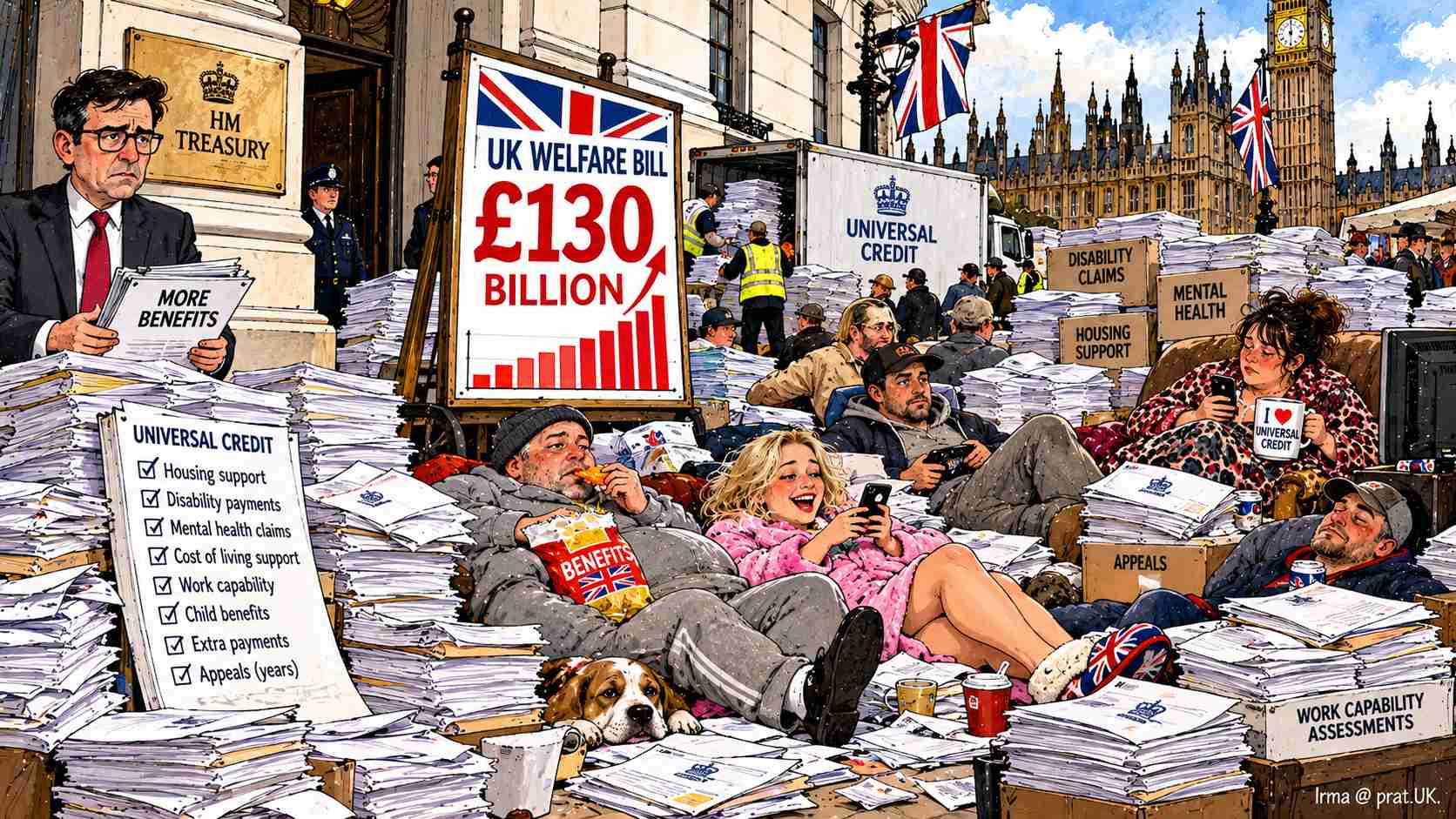
Britain's Welfare Bill Heads for £130 Billion as Treasury Unveils "Mutually Assured Dependency" Defence Doctrine
Ministers Say Invaders Will Surrender Before Their First Universal Credit Form Is Processed
LONDON — Britain's health and disability benefits bill is heading for roughly £130 billion a year by 2030, according to a Wall Street Journal investigation into Britain's welfare state, and the Labour government has greeted the figure as proof that the country is finally outgrowing the old custom of swapping labour for money.
A spokesman for the Department of Economic Liberation said the numbers showed "a nation at ease with itself." Asked who would be paying for it, he said the department had a form for that.
Disability Claims Climb as the Treasury Goes Looking for Taxpayers
The Institute for Fiscal Studies analysis of disability benefit claims puts the share of working-age people claiming disability benefits in England and Wales at 8.2% in August 2025, up from 5.5% in August 2019. The same analysis shows working-age disability benefit spending rising from £25 billion in 2025–26 to a forecast £34 billion by 2030–31. The Journal reports that claims have grown by more than 60% since 2019.
Disability benefits can also support people who are in work, and many claimants have serious physical or mental health conditions. Nobody at the Treasury disputes that. The dispute is over the arithmetic.
One senior Treasury adviser, who asked not to be named, explained the department's philosophy over a vending-machine coffee. "Capitalism makes people work for their money," he said. "Socialism lets them receive money without working, provided we can find enough capitalists to cover it. The difficulty is that the capitalists eventually notice."
Britain's Remaining Workers Reclassified as a Protected Minority
The average British employee works Monday to Friday, pays income tax, National Insurance, council tax and VAT, and still has enough left over for a sandwich containing a microscopic amount of cheese. Under the new arrangement, that employee will also carry the country's expanding welfare commitments. The employee has not been consulted.
A London electrician stopped for comment outside a Tube station said he had spent six years learning to wire buildings. "My mistake was developing a marketable skill," he said. "I should have studied how to fill in forms." He is now considering retraining as a government administrator, where he would be paid to process the forms he would otherwise have completed himself.
A plumber from Croydon named Nigel has been told he is on course to become the last employed taxpayer in Britain. He will be summoned to Downing Street and given a commemorative medal. "I've been informed it will be taxed as a benefit in kind," Nigel said.
DWP Assessment Questions Reach the Surreal
Officials at the Department for Work and Pensions have circulated a draft capability test. A transcript seen by this newspaper runs as follows.
"Can the applicant lift a brick?"
"Yes."
"Can the applicant deliver the same brick to a building site?"
"Absolutely not. That's employment."
A leaked proposal would also lengthen the standard disability questionnaire to 900 pages. Anyone who completes it without developing a psychological condition would automatically be declared fit for work. The government's Pathways to Work benefit reform impact assessment contains rather fewer pages and, as far as anyone can tell, no bricks.
Royal Navy Told to Apply for Personal Independence Payment
The Journal reports that spending on sickness and disability benefits has passed £100 billion a year, a sum larger than the defence budget. The two figures cover different categories of spending, but the comparison has been warmly received in Whitehall.
The Ministry of Defence has told the Treasury that several warships suffer from chronic mechanical problems and may qualify for assistance. HMS Prince of Wales was asked to complete a questionnaire. Question one: can the applicant walk 50 metres without help? The aircraft carrier answered no, and the Treasury approved enhanced mobility support. The payment came to rather less than the cost of running an aircraft carrier, so navy officials have been told to look into registering the whole fleet as one large household.
An RAF spokesman said Britain has excellent pilots, sophisticated aircraft and a proud tradition. "What we're short of is money," he said. "Apparently we should have joined the Department for Work and Pensions."
"Mutually Assured Dependency" Replaces Nuclear Deterrence
Government sources describe the new national security strategy as economic exhaustion. Any hostile power attempting an invasion would automatically make its population eligible for a range of expensive public programmes. NATO officials have reportedly begun calling the approach Mutually Assured Dependency.
"Previously, we threatened enemies with nuclear retaliation," one defence analyst said. "Now we threaten them with responsibility for the British budget."
The Army is meanwhile weighing retraining infantry as benefits administrators, on the grounds that soldiers already understand uniforms, discipline and complicated instructions. A sergeant with eighteen years of service said he had been told the real enemy was an incorrectly completed Universal Credit form. The new recruitment slogan will read: be the best you can be, but remember that being your best may affect your eligibility.
The Circular Prosperity Model Explained
Treasury officials walked reporters through what they call the Circular Prosperity Model. A worker earns £100. The government collects £40. The worker, now struggling with housing, transport and food, receives £20 in assistance and thanks the government for its generosity. Economists call this redistribution. Accountants call it an exceptionally expensive way to move money from one pocket to another. The Treasury calls it growth.
A separate study asked why British firms hesitate to invest when taxes and employment costs rise. Its findings included the observation that employers dislike unpredictable bills and that investors prefer profitable businesses. An economic adviser said the report contradicted the department's central assumption. "Apparently companies have to make money before we can confiscate it," he said. "Nobody mentioned that on my public administration degree." A committee will now examine whether the principle can be repealed.
A Treasury consultation found that 94% of respondents supported generous public spending provided somebody else paid for it. The other 6% were still working out their own tax bill.
What the Official Forecasts Actually Say
The Office for Budget Responsibility welfare trends report of June 2026 tracks the cost in detail, including an estimated £10.3 billion in overpayments from fraud and error across all welfare in 2026–27. The Chancellor has welcomed the scrutiny and announced a Committee for the Prevention of Unnecessary Employment. It will employ 1,200 people. Its first job is to decide whether any of them are necessary. Its second is to ask for a bigger budget.
By the end of the decade, ministers hope every citizen will receive a government payment, every payment will need a civil servant, every civil servant will need a supervisor, and every supervisor will need an inquiry into why productivity collapsed. At that point the Treasury will have achieved complete economic equality. Nobody will have any money, but everybody will have a government form explaining why.
Five Humorous Observations
- They've built a national defence strategy around paperwork. The Russians spent decades on hypersonic missiles, and our answer is a form asking whether you can walk fifty metres. They'll be on hold with the DWP till Easter.
- Only the British government can hand you a medal and then tax you for wearing it. That's like winning the lottery and getting a letter asking where your receipts are.
- The Treasury has discovered that taxes need taxpayers. That's like opening a restaurant and being shocked that people expect you to have food.
- You pay income tax, National Insurance, council tax and VAT, and your reward is a sandwich with a rumour of cheese. That's not lunch. That's a bread-based apology.
- Eighteen years in the army, trained to run toward gunfire, and now you sit politely while a man called Gary explains why your claim is "pending." Honestly, the gunfire sounds more relaxing.
This article is political satire. Officials, quotations, programmes and eyewitnesses are invented for comic effect and are not verified reporting. The cited statistics and forecasts come from the linked sources. Disability benefits serve people with genuine needs, and claiming one is not evidence of fraud or unwillingness to work. Source: Wall Street Journal. https://prat.uk/britains-welfare-bill-heads-for-130-billion/
Comments
Post a Comment