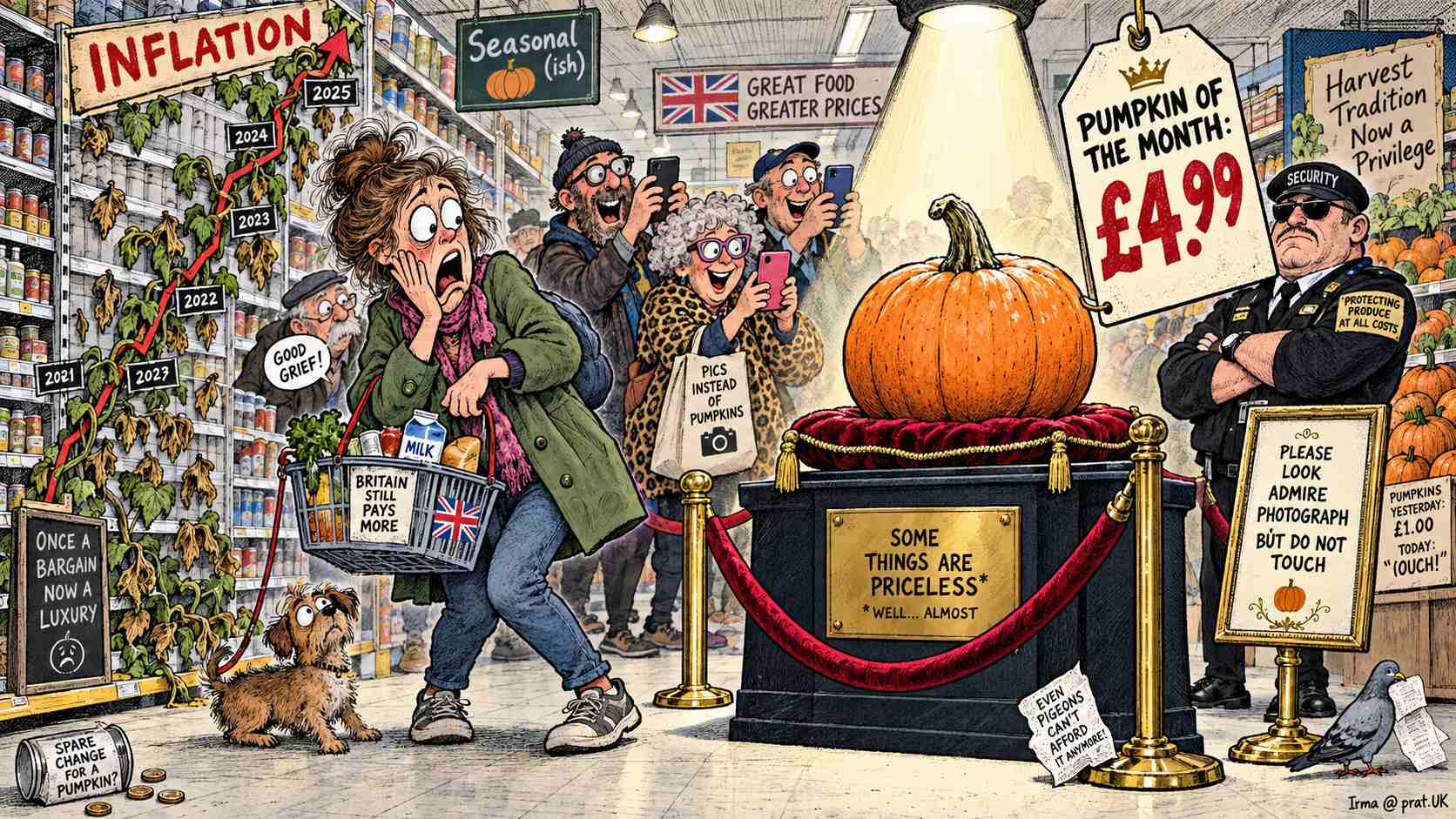
Pumpkin Prices Britain: Nation Blames Weather, Brexit and Each Other
Shop price inflation is nudging back up, and the humble jack-o'-lantern is not being spared
MANCHESTER — A shopper in a Manchester supermarket this week was overheard describing a £4.99 pumpkin as "an act of psychological warfare," before placing it in her trolley anyway, alongside a bag of sweets she also described as psychological warfare, and a bottle of wine she notably did not describe at all. Pumpkin prices Britain has become a genuine autumn talking point, and for once the complaining is not entirely theatrical.
Official figures show shop price inflation climbed to 1.5 per cent year-on-year in January, the highest level in almost two years, driven by elevated energy costs and the rise in employer National Insurance contributions working their way through the supply chain. Food inflation alone hit 3.9 per cent that month, with fresh food, the category pumpkins fall into, running even hotter at 4.4 per cent. None of this is a Halloween story specifically. All of it lands on Halloween anyway, because pumpkins, inconveniently, are food, and food has not been getting cheaper.
Why pumpkin prices Britain varies so wildly by postcode
The variation between retailers is where the real farce begins. Budget chains have previously undercut premium supermarkets by as much as 57 per cent on a large carving pumpkin, selling a "large" for roughly £1.49 against a comparable item elsewhere priced north of £3.50, with the smallest decorative "munchkin" varieties showing an even starker gap. A pumpkin, in other words, is not one product with one price. It is a postcode lottery wearing a stalk.
A Mancunian comedian doing a Halloween-themed set this week summed up the national mood with characteristic bluntness: "We complain about inflation for eleven months of the year, then in October we walk straight past three identical pumpkins at three different prices and buy the most expensive one because it 'looked friendlier.' That's not economics. That's a hostage situation with a smile carved into it."
The bigger picture behind pumpkin prices Britain
There is a genuine supply story underneath the jokes. Wet growing seasons and pest pressure have, in past years, cut UK pumpkin yields sharply enough to push wholesale prices up by around 30 per cent almost overnight, sending the typical carving pumpkin from the usual £2 to £3 bracket up toward £3 to £5, with some shoppers switching to squash and turnips rather than pay it. Anyone old enough to remember carving a turnip lantern, the original and considerably harder-to-hollow British tradition, may feel this counts less as innovation and more as a return to painful ancestral form.
Inflation watchers, for their part, have noted the picture is not uniformly bleak. Overall shop price inflation actually eased slightly the following month as retailers leaned on competition and promotions, which is the kind of detail that will comfort absolutely nobody standing at a supermarket display doing mental arithmetic on four pumpkins for a children's party.
How pumpkin prices Britain compares across the supermarket shelf
Budget retailers have made something of a seasonal sport out of undercutting their rivals on pumpkins specifically, with one chain's giant pumpkin priced roughly £2.10 cheaper than a comparable item elsewhere, and its smallest decorative variety coming in at nearly 60 per cent below the priciest equivalent on the market. For a vegetable that exists almost entirely to be carved, photographed and binned within a fortnight, the price gap between retailers has become disproportionately large, to the point where some households now plan an entire cross-town shopping trip around securing the cheapest gourd rather than the nearest one.
Wholesalers, for their part, point out that pumpkin margins are thin even before a bad growing season, since the crop occupies a field for months to be sold, almost entirely, across a single fortnight in late October. Any disruption to that narrow window, whether from weather, pests or simple bad luck, shows up in the final shelf price far more sharply than it would for a vegetable sold steadily across the whole year, which goes some way to explaining why pumpkin prices Britain can swing so dramatically from one autumn to the next.
Trick, treat, or receipt
Households spending on Halloween have historically been remarkably resistant to price sensitivity, with pumpkin sales climbing by double-digit percentages even in years when household budgets were under obvious strain elsewhere. Britain, it turns out, will happily economise on almost anything except the one vegetable it only uses for a face and then throws away a week later.
For the fuller inflation picture behind this year's shopping basket, Latest Story UK carries the more detailed breakdown of food price trends heading into the winter.
Sources
Trading Economics: UK shop price inflation hits near two-year high and Aldi Press Centre: cheapest supermarket pumpkins comparison.
This has been a helping of British satire for a nation that will haggle over a fiver on a phone contract but pay whatever a pumpkin demands, presented in the spirit of proper UK satirical news. For the American take on Halloween-season sticker shock, visit Bohiney.com.
Auf Wiedersehen, amigo! https://prat.uk/?p=47690
Comments
Post a Comment