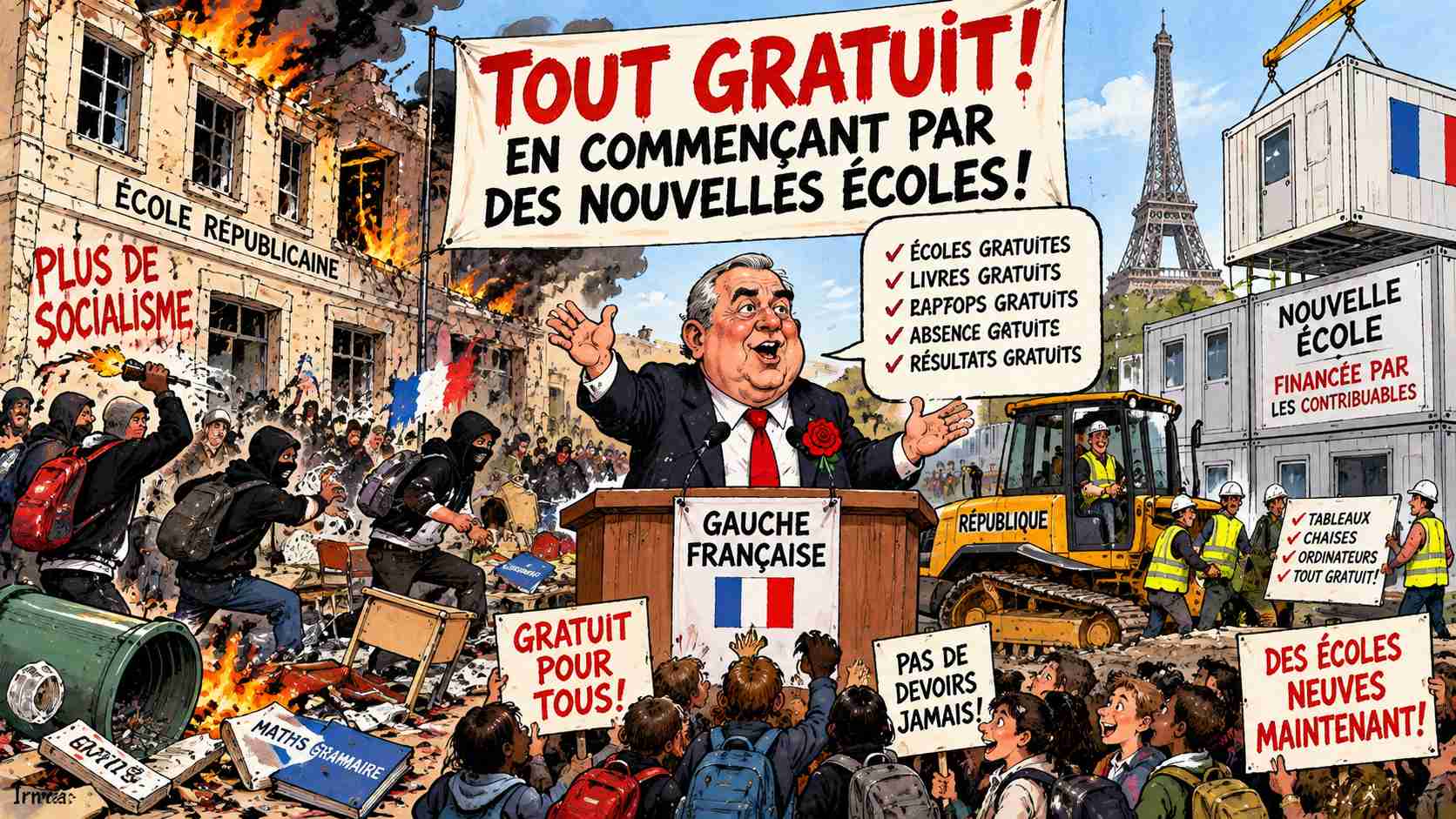
Socialist Economics Reaches Its Logical Conclusion: Everything Is Free Until Somebody Asks Who's Paying
PARIS, FRANCE | France's education crisis has revived an old argument: if public services are free, why does everything that provides them cost so much? The question is urgent now that the government faces decaying schools, teacher shortages, public debt and damage from student unrest.
The unrest has also complicated preparations for the 2027 budget, with the government under pressure to contain spending while answering demands for greater investment in schools, The Arabian Post reported.
The French Left's Answer to the Education Budget
The French left has a reliable solution. Spend more. When that fails, spend considerably more. When that creates a deficit, find a wealthy person and accuse him of insufficient patriotism.
It's a pleasant programme, as long as nobody opens the accounts.
Opening the accounts is treated at most rallies the way a spoiler is treated at the cinema. Everybody already knows how it ends. Nobody wants it said out loud before the speeches are over.
The trouble starts with the word "free." Free education needs teachers who expect salaries. Free universities need buildings somebody had to construct. Even free government advice needs a civil servant, an office, a pension and about seventeen forms explaining why the advice wasn't available yesterday.
The word "free" has done heroic service in French politics. It has paid for nothing and taken credit for everything. If it were a civil servant it would have retired years ago on a full pension, and somebody would now be paying the pension.
Who Pays for the Repairs After Student Protests?
Now there's a new line on the bill. Damaged schools have to be repaired, often with tax revenue that already wasn't enough to maintain them.
A French bureaucrat could spend an entire career walking around it. The government collects taxes to build a school. The school deteriorates. Students demand improvements. Somebody damages the building. The government collects more revenue to repair it.
Everyone complains that public services are getting more expensive. Nobody can work out why.
The loop could be broken at any stage. Maintain the school before it crumbles. Protect it before anybody reaches for a match. Instead the state waits for the most expensive possible moment and pays then, which is the budgeting equivalent of skipping the dentist for ten years to save money on the dentist.
Justice Minister Gérald Darmanin has said authorities are considering making parents financially responsible for damage their children cause, per the Free Press Journal. So the bill may finally have a name on it.
This could unsettle the entire system. For decades, French public bills have been addressed to the State, which forwards them to the taxpayer, who forwards them to the bank, which forwards them to the next government. An envelope with a real name on it may need its own procedure, and possibly its own department.
The Exchange Rate on a Box of Matches
A box of matches costs almost nothing. The building it can ruin took decades of tax revenue to put up and decades of neglect to get into its current state. It is the worst exchange rate in Europe, and France has managed to lose on both sides of the trade.
Most of the people asking for better schools never go near a match. They march, chant, paint placards and go home. The few who do strike one are adding a line to the very budget everyone else is marching about. That is not a demand. It is a withdrawal.
Why Taxing the Rich Won't Fix French Schools Alone
France could in theory pay for everything by taxing billionaires, provided the billionaires stay available. They have irritating habits, including accountants, passports and easy access to airports.
That leaves the middle class, which has always financed the promises politicians make to everyone else. The taxpayer now supports a school system with a leaking roof and sends his own children to it.
He is the most reliable resource the Republic has. He cannot emigrate, because nobody will buy his flat for what he paid. He cannot hide his money, because there is not enough of it to hide. He simply pays, then queues at the prefecture to find out what he paid for.
Public support for fixing education is real. An Elabe poll for BFM TV, reported by Reuters, found 72 percent of French people consider the students' demands legitimate, while 55 percent think the protests should stop. France agrees schools should improve, but would like the revolution wrapped up before Monday morning.
A reasonable plan exists: put essential education first, maintain buildings, protect property and spend the available money well. It offers very few openings for revolutionary speeches, which may be why nobody has tried it.
The French state can't make resources unlimited by declaring them free. And setting fire to something doesn't make its replacement cheaper. If anything, it produces the one commodity France has in unlimited supply.
Another government bill.
Five Humorous Observations
- "Free" in France means you don't pay at the door. You pay later, in the form of everything.
- Free government advice comes with seventeen forms. Seventeen! That's not free, that's a subscription to paperwork.
- Tax the billionaires. Great plan. Have you seen where they are right now? Not here. They've got a gate number.
- Seventy-two percent say the demands are fair, fifty-five percent want it over. That's the most French poll ever: yes, but not on a school night.
- The one thing France never runs out of is the invoice.
Satire based on reported events in France. The policies and humor are invented. Peaceful protesters shouldn't be confused with those responsible for violence. Readers wanting more British satire, or a quick guide on how to tell satire from real news, can have both free, and this time it really is free. https://prat.uk/?p=51980
Comments
Post a Comment